
When asked if the Indian investigating agency would be allowed to visit Pakistan, Basit said that 'the whole investigation is not about reciprocity in view'.

In Shujaat Bukhari, Kashmir has lost a journalist, an activist, ambassador, a formidable voice and, above all, a great human being, mourns Athar Parvaiz.

'India's real concern is that cash-strapped Pakistan is keeping its military hardware well oiled on American money,' says Rajeev Sharma.

'We have a common way of looking at the world, a common way of thinking, and a common set of values that predispose us to be partners. And our interests overlap greatly,' Dr Ashton B Carter, America's next defence secretary, told Aziz Haniffa/Rediff.com in an exclusive interview.

'Afghanistan cannot be at peace until the Pashtuns regain their pre-eminent role in the country's governance,' says Ambassador M K Bhadrakumar.
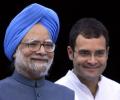
Indicating he was ready to don any role in the Congress after the 2014 general elections, Prime Minister Manmohan Singh on Saturday said he will be "very happy" to work under the leadership of Rahul Gandhi.

'In India foreign policy is generally handled by the prime minister.' 'One can clearly see the Vajpayee stamp on all this.' 'Only a person with poetic imagination can weave such a complex web,' says Colonel Anil A Athale (retd).

'A couple of hours before the H-Hour, the Kupwara division opened small arms and mortar fire on posts opposite its area of operation.' 'This was a diversionary tactic.' 'As Pakistani forces began to react to the firing, special forces teams began to slowly cross the LoC into PoK.' Nitin Gokhale reveals how planning for the surgical strikes began hours after the Uri attack.

'Will Muhammad Habib Zahir -- who was part of the team that arrested Kulbhushan Jadhav and went missing in Nepal -- figure in a Jadhav-for-Zahir deal?' asks Aditi Phadnis.

Aziz also attended a dinner where he exchanged pleasantries with PM Modi.

In a turnaround, Pakistan asked for "more evidence and information" from India on the Mumbai attack case and asserted that talks cannot take place without Kashmir being on the agenda, barely three days after the two countries agreed to re-engage.
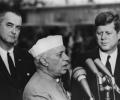
As Prime Minister Narendra Modi begins his historic visit of the United States of America, here's a look at some landmark visits by Indian prime ministers to the United States of America.

The upcoming Indo-Pak National Security Adviser-level talks appeared to be on the verge of being aborted with both sides locked in a confrontation over Kashmiri separatist leaders.
If Pakistan allows India to send its investigation team to question Azhar it would take the India-Pakistan camaraderie to a new level, says Rajeev Sharma.

Tillerson said China's behaviour and action is "posing a challenge to the rules-based international order".

Both India and South Korea will use President Park Geun-hye's visit to unveil a comprehensive programme for mutual benefit and impacting on regional security environment, says Srikanth Kondapalli.

'Nawaz Sharif knows a coup in 2016-2017 will not only complete Pakistan's isolation, but even a whiff of instability will frighten the world into imagining another Islamic State-zone, and this in a fully nuclearised subcontinent,' says Shekhar Gupta.

'Pakistan persists in the belief that such attacks will enable it to obtain the territory it covets. Their plans will not succeed.'

'There is gradual rise in the number of nations viewing Pakistan as the nursery of global terror.'

External Affairs Minister Salman Khurshid on Wednesday said Prime Minister Manmohan Singh during meeting with his Pakistani counterpart Nawaj Sharif on September 29 in New York will obviously send 'some significant signals' to Islamabad about India's concerns on cross-border terrorism.

'If the US-Pakistan relationship continues to suffer, Pakistan may feel it has less to lose and decide that it need not keep a leash on LeT in order to appease America.' 'A tougher US policy toward Pakistan could lead to an emboldened and strengthened LeT and JeM, resulting in more terrorist attacks in India.'
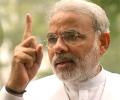
To be sure, Modi is no Vajpayee; at least that is the impression he gives. However, this doesn't mean that he will be looking for a fight. All it means is that if Pakistan seeks a fight, he will not back down. What it also means is that the pusillanimous approach of the previous governments to ceaseless provocations from Pakistan will probably change, says Sushant Sareen.
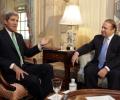
Pakistan Prime Minister Nawaz Sharif continues his exhortation for US mediation in Kashmir, and harks back to his meeting with former Prime Minister Atal Bihari Vajpayee when the latter had agreed to a resolution of Kashmir imbroglio; senior us officials assert there is 'absolutely no change in us policy' that Kashmir has to be resolved bilaterally. Aziz Haniffa reports.

The cascade of cordiality on both sides after the Modi-Sharif handshake in Paris was preceded by much planning and even goading from UK, US and Germany.

'I could see it not having any impact whatsoever,' says Stephen P Cohen on Obama's India visit.

Rediff.com reproduces the translation of the remarks made by President Ashraf Ghani at a press conference.

'It seems that the BJP in its desire to catapult Modi onto the international stage, knowing the image deficit due to visa denials, has caused unhappiness in Tamil Nadu, uncertainty in Bangladesh and a churning in Pakistan that Sharif may or may not be able to control,' says Ambassador K C Singh.

'The entire Ufa fiasco was predictable and predicted. The Ufa venue had created international interest in the initiative and its failure may have implications for both Pakistan and India. What remains for Modi to do is to produce a prettier rabbit out of his hat next time to deal with the Pakistan imbroglio,' says Ambassador T P Sreenivasan.

'If there's one administration that would be likely to put the squeeze on Pakistan, it's the Trump administration.' 'This is an administration that views terrorists as a black and white issue (kill them all, no questions asked), and will have little patience for Pakistan's selective policy toward terrorism.'
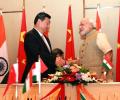
'China's actions at the NSG will certainly taint India-China bilateral relations and enhance suspicion of China's intentions. A fresh clear-eyed and objective evaluation of the India-China relationship is necessary, especially as India tries to correct adversely balanced bilateral economic ties and the two countries engage over the long-term,' says Jayadeva Ranade.
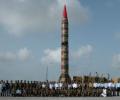
Saudi Arabia has invested in Pakistani nuclear weapons projects and believes it could acquire atomic bombs "at will", the BBC reported on Thursday.

'This was undoubtedly a premeditated strategy to thwart India's entry into the NSG.' 'If India hopes to be a major player, it must use its rising clout on the world stage to influence amenable members of the group to alter such discriminatory practices and ensure fair rules of engagement,' says Vivek Gumaste.

The question really is whether the US can be persuaded to embark on a path of calibrated and stronger sanctions on Pakistan.

But the US will sell F-16 aircraft to Pakistan to fight 'terrorists.'
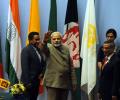
'If his three priorities are the economy, the economy, the economy, then there is need for a stable region, a stable neighbourhood.'

Vikas Swarup says India unlikely to give Pathankot-like offer to Pak in Uri attack probe.

'The US-India relationship is in a different league altogether,' Obama administration officials tell Aziz Haniffa/Rediff.com in Washington, DC.
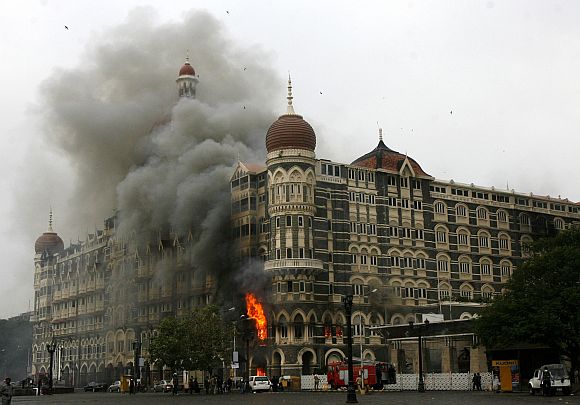
'Headley's testimony indicates to what extent the Pakistan government and its proxies can go to destroy not only Indian scientific talent but also international expertise.'

'While military acts such as the Uri surgical strikes are one option, cultural, economic and diplomatic isolation should also be part of the arsenal,' argues Sankrant Sanu.
India's low passion, very cautious, relationship with Iran of the last 36 years awaits transformation, says Lieutenant General Syed Ata Hasnain (retd). Prime Minister Modi's visit cannot be a negotiating event; it is a symbolic one to strengthen the politico-diplomatic relationship.
